
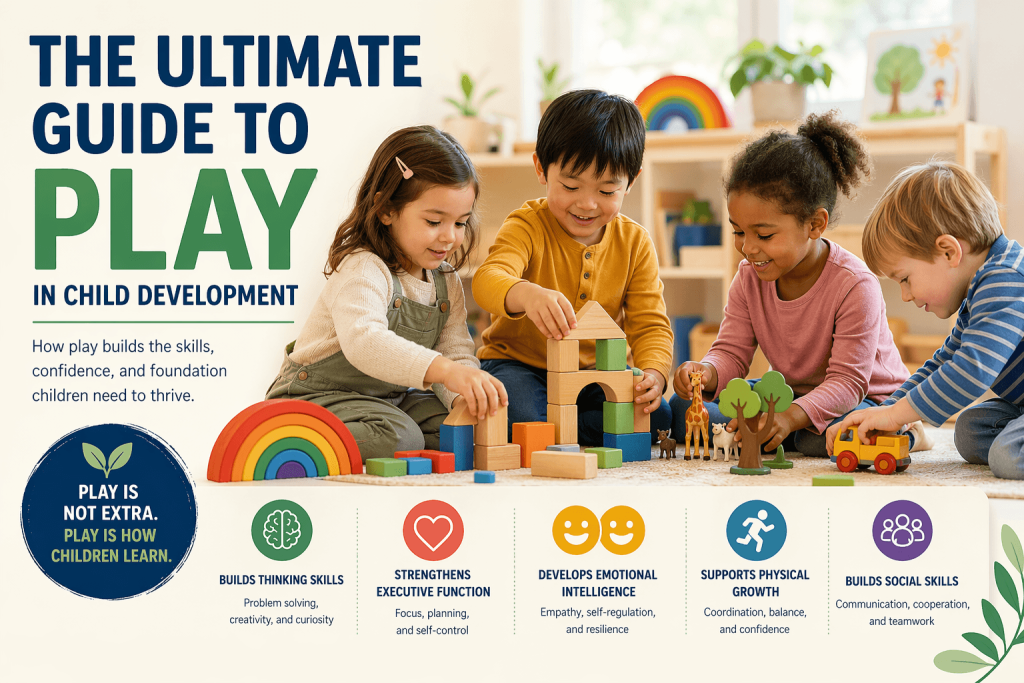
The Ultimate Guide to Play in Child Development
TL;DR
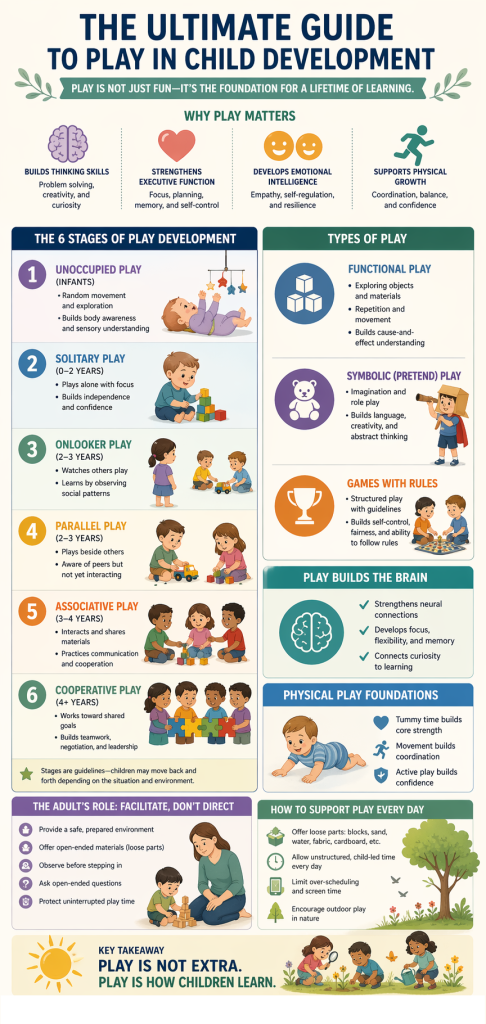
- Developmental Milestones: Children progress through six distinct stages of play, ranging from unoccupied sensory exploration to complex cooperative teamwork, each building essential social, cognitive, and physical foundations.
- Brain Architecture: Play is a rigorous intellectual process that strengthens executive function, emotional intelligence, and problem-solving skills, serving as a critical bridge between natural curiosity and academic mastery.
- Pedagogical Value: Different forms of play (functional, symbolic, and rule-based) offer unique educational benefits, helping children transition from concrete understanding to abstract reasoning and social self-regulation.
- The Adult’s Role: Success in play-based learning requires adults to act as facilitators rather than directors, providing a prepared environment and “loose parts” that encourage independent discovery and resilience.
Table of Contents
- The Essential Benefits of Play in Child Development
- The Six Stages of Play Development
- Unoccupied Play: The Earliest Sensory Exploration
- Solitary Play and Independent Discovery
- Onlooker Behavior and Social Observation
- Parallel Play: Side by Side Interaction
- Associative Play: Learning to Interact
- Cooperative Play: Collaboration and Teamwork
- The Role of Tummy Time and Physical Play
- Why Play is the Foundation of Learning
- Types of Play and Their Pedagogical Value
- The Role of the Adult: Facilitating vs. Directing
- Integrating Play into Educational Curricula
- Overcoming Challenges to Play in Modern Childhood
- Frequently Asked Questions
Play serves as the primary mechanism through which children interpret the world. It is not merely a leisure activity but a rigorous intellectual process that shapes the architecture of the developing mind.
At Trillium Montessori, we view play as the essential work of childhood. It provides a safe laboratory for testing hypotheses, practicing social roles, and mastering physical coordination.
Understanding the progression of play allows educators and parents to support children more effectively. This guide examines the developmental trajectory of play from infancy through the school years.
The Essential Benefits of Play in Child Development
Play-based learning serves as the primary engine for cognitive growth, acting as a natural bridge between curiosity and mastery. It enhances problem solving, creativity, and calculated risk-taking while building vital social-emotional skills in a low-stakes environment. By engaging in self-directed activities, children learn to negotiate rules and experiment with various outcomes without the fear of failure.
Research from the Harvard Graduate School of Education suggests that these experiences are critical for structural brain development. Specifically, play strengthens executive function, the mental processes that enable us to plan, focus attention, and juggle multiple tasks simultaneously. This neurological scaffolding allows children to eventually navigate more complex social and academic structures with confidence.
Furthermore, children engaged in deep imaginative play demonstrate superior emotional intelligence. By stepping into different roles, they develop empathy and learn to regulate their own behavior during stressful or high-stakes situations. This internal regulation is a key predictor of long-term academic success and interpersonal stability.
The Six Stages of Play Development
Building on these foundational benefits, sociologist Mildred Parten identified a clear progression of how children’s social interactions evolve. In her landmark research published in the Journal of Abnormal and Social Psychology, she categorized six distinct stages that serve as a roadmap for healthy maturation. These stages track the transition from internal sensory focus to complex, collaborative group dynamics.
While these milestones generally follow a chronological order, they are fluid guidelines rather than rigid deadlines. A child might fluctuate between different styles of interaction depending on their energy levels, the novelty of their environment, or the specific toys available. Each phase represents a shift in how a child perceives their peers, moving from seeing them as mere background objects to essential partners in a shared goal.
Recognizing these patterns allows educators and parents to tailor their support to a child’s current capabilities. By observing which stage a child is currently inhabiting, you can provide the specific materials and social opportunities that challenge them just enough to encourage the next leap in their social development.
Unoccupied Play: The Earliest Sensory Exploration
This developmental journey begins with Unoccupied Play, which is most prevalent in infants during their first few months of life. Although it may not look like “play” in the traditional sense, this stage is characterized by seemingly random movements and an intense, quiet observation of the immediate surroundings. It is the first time a child begins to manipulate the “safe laboratory” mentioned in our introduction.
During this stage, you will notice your baby kicking their legs, reaching for shadows, or staring intently at their own hands. These actions are fundamental to proprioception, the sense of self-movement and body position. By repeated experimentation, the infant begins to understand the cause-and-effect relationship between their intentions and their physical actions.
This period of solitary sensory processing is vital for neurological integration. It allows the infant to map their own physical boundaries and refine their motor responses. This internal focus creates the necessary baseline of physical confidence required before a child can eventually turn their attention outward toward toys or other people.
Solitary Play and Independent Discovery
As the child gains more physical control, they transition into Solitary Play, a phase typically seen between the ages of three and twenty-four months. While the infant was previously focused on their own body, the toddler now directs that same intense focus toward external objects. During this stage, children play contentedly on their own, often ignoring the activities of others nearby.
This phase is an essential incubator for sustained concentration and creative thinking. When a child spends twenty minutes trying to fit a wooden peg into a hole or examining the texture of a leaf, they are practicing “flow”, a state of deep task absorption. This independence fosters a sense of agency, teaching the child that they are capable of entertaining themselves and solving problems without constant adult intervention.
Child development experts at organizations like Pathways.org highlight that this preference for playing alone is a healthy, necessary milestone. It builds a foundation of self-reliance and autonomy. Rather than a sign of social withdrawal, solitary play provides the child with the “quiet work” time needed to master basic tools and concepts before they are asked to share those experiences with a peer group.
Onlooker Behavior and Social Observation
Building upon the self-reliance gained during solitary play, onlooker behavior, often called spectator play, typically emerges between the ages of two and three. During this phase, a child stands within earshot of a group, watching their peers with intense focus but stopping short of joining the activity.
While an observer might mistake this for shyness or hesitation, the child is actually performing a sophisticated cognitive analysis. They are mentally “mapping” the social landscape, deciphering the unspoken rules of a group, and cataloging the specific vocabulary their peers use to negotiate space and resources.
By treating play as a live demonstration, the child builds the confidence necessary to eventually transition from the sidelines to the center of the action. This observational period serves as a low-risk environment for learning how to navigate complex social hierarchies and understanding the functional use of unfamiliar objects through the actions of others.
Parallel Play: Side by Side Interaction
Once a child feels comfortable in the presence of others, they naturally transition into parallel play. This stage involves children playing in the same immediate area, often utilizing similar materials, yet maintaining their own independent agendas without a unified objective.
This physical proximity fosters a burgeoning sense of social tolerance and environmental awareness. It represents a vital developmental shift where the child acknowledges the “other” while still prioritizing their own creative process. It is a dress rehearsal for intimacy, allowing children to enjoy the comfort of companionship without the immediate pressure of complex negotiation.
Beyond simple proximity, this stage introduces the concept of territorial boundaries and mutual respect. Children begin to observe “body language cues” and learn to manage the distractions of a shared environment, which are essential prerequisites for the more demanding collaborative efforts that lie ahead.
Associative Play: Learning to Interact
As the child’s social curiosity matures, usually between the ages of three and four, the invisible walls of parallel play begin to dissolve into associative play. In this phase, the focus shifts from the toys themselves to the people playing with them, though the activity still lacks a formal structure or a singular finished product.
You will notice children frequently talking to one another, borrowing a shovel to finish their own sandcastle, or following each other around a playground. These interactions are spontaneous and fluid; the primary goal is the social connection itself rather than the completion of a specific task. It is the first time children truly begin to practice the “give and take” of verbal communication.
This stage is a critical laboratory for experimenting with social influence and mimicry. By engaging in these loose associations, children refine their ability to express desires, ask for permission, and interpret the emotional responses of their playmates, all while retaining their personal autonomy.
Cooperative Play: Collaboration and Teamwork
The culmination of these developmental steps is cooperative play, which typically takes center stage around age four. Unlike the loose associations of the previous phase, this stage is characterized by organized group efforts, shared goals, and the adoption of specific roles, such as a “captain” in a game or a “builder” in a construction project.
Whether they are designing an elaborate fort or navigating a game with established rules, children are now forced to negotiate, compromise, and defer their immediate impulses for the good of the group. This high-level interaction is where true emotional intelligence is forged, as children learn to handle the frustrations of losing and the responsibilities of leadership.
Mastering these collaborative dynamics is essential for a successful transition into a classroom setting. Educational platforms like ABCmouse emphasize that this ability to work toward a common objective is the primary indicator of school readiness, as it combines cognitive problem-solving with the sophisticated social-emotional maturity required for lifelong success.
The Role of Tummy Time and Physical Play
This journey toward social-emotional maturity begins with the physical body. Long before a child can collaborate in a group, they must establish the physiological foundations of movement. Tummy time serves as the first “workout,” strengthening the neck, back, and core muscles necessary for later milestones like sitting up and crawling. These early physical exertions are not merely exercise; they are the child’s first experience with overcoming gravity and gaining agency over their environment.
As toddlers graduate to dynamic movements like running, climbing, and jumping, they engage in “rough and tumble” or locomotor play. These activities facilitate proprioception, the body’s ability to sense its location and movement in space. By mastering physical coordination, children develop a sense of self-efficacy. This confidence acts as a bridge, transforming physical mastery into the resilience required to tackle complex intellectual challenges and navigate the social dynamics of a playground.
Related Video
Six Stages of Play (Mildred Parten), Explained!Stages illustrate the evolution of a child’s social development within play contexts: In this video, we will look at each stage of play.Watch Video on YouTube →
Why Play is the Foundation of Learning
Beyond the physical benefits, play acts as a rigorous laboratory for the brain, building the essential cognitive architecture known as executive function. When a child is deeply engaged in play, they are practicing focus, working memory, and mental flexibility. This sensory-rich exploration triggers neural synaptogenesis, creating the pathways used for higher-order thinking. It is during these moments of intrinsic motivation that a child’s brain is most receptive to learning new concepts.
This cognitive growth is often categorized by the level of social interaction involved. Research into developmental psychology highlights how children move from solitary exploration toward sophisticated group dynamics. This progression is not just about making friends; it is about the gradual decentralization of the self. By observing others and eventually negotiating shared rules, children learn to balance their own desires with the needs of the group, a skill that is fundamental to academic success and future professional life.
Types of Play and Their Pedagogical Value
While the social stages describe who the child plays with, the specific type of play defines the pedagogical lessons being learned. These categories often overlap, providing a multi-layered approach to early childhood education that targets different areas of the brain simultaneously.
Functional Play
This involves the repetitive use of objects to understand how they work. Whether it is banging a spoon or stacking blocks, this type of play introduces the basics of cause and effect. It establishes the foundations for scientific inquiry, as children form and test hypotheses about the physical world and their own motor control.
Symbolic and Pretend Play
As cognitive abilities expand, children begin to use objects to represent something else, such as using a cardboard box as a spaceship. This “as-if” behavior is a major milestone in abstract thinking. It requires the child to hold a mental image in their mind while interacting with the physical world, a process that is directly linked to future literacy and mathematical reasoning.
Games with Rules
The final transition involves structured activities with established constraints. Whether playing a simple board game or a sport, children must learn to regulate their impulses and adhere to shared guidelines. This type of play teaches the social contract of fairness, the ethics of competition, and the self-regulation required to handle both victory and defeat with grace.
The Role of the Adult: Facilitating vs. Directing
While structured rules provide a framework for fairness, the adult’s primary role is to act as a scientific observer rather than a director, providing the scaffolding necessary for self-directed cognitive growth. By curating a prepared environment with accessible, high-quality materials, you foster independence and deep concentration. This shift from leader to facilitator allows the child’s natural curiosity to dictate the pace of learning, ensuring that the motivation for discovery remains internal rather than performative.
Observational Techniques and Support
Effective facilitation requires knowing when to step back. Protecting a child’s flow state during play encourages autonomous problem-solving and grit. Intervene only when frustration threatens to halt progress entirely, and even then, offer the minimal assistance required to overcome the immediate hurdle. Instead of dictating the “correct” way to use a toy, use open-ended questions like “What do you think happens if we move this?” to spark hypotheses. This approach strengthens the prefrontal cortex, building the neural pathways essential for executive function, emotional regulation, and complex reasoning.
Integrating Play into Educational Curricula
Building on these facilitative techniques, modern educators are increasingly transforming classrooms into dynamic environments where academic concepts emerge naturally through play-based learning. By integrating literacy and math into imaginative scenarios, such as calculating totals in a pretend café or labeling “specimens” in a play laboratory, educators provide essential context for abstract logic. This contextualization ensures that children do not just memorize facts, but understand the utility of knowledge in real-world applications.
The Stages of Play Development
To effectively integrate play into education, teachers must recognize Mildred Parten’s research, which outlines how children progress socially through distinct stages. Understanding these milestones ensures that curriculum activities are age-appropriate and developmentally aligned:
- Unoccupied and Solitary Play: Common in infants and toddlers, where the focus is on self-exploration, sensory processing, and mastering core motor skills.
- Onlooker and Parallel Play: A transitional phase where children observe peers or play nearby with similar materials, building the social awareness necessary for later interaction.
- Associative and Cooperative Play: The most complex stages, typically appearing in preschoolers, where children negotiate roles, share resources, and collaborate toward a shared objective.
Overcoming Challenges to Play in Modern Childhood
Despite the clear developmental benefits of these social stages, modern childhood faces unique obstacles that can stifle unstructured exploration. The rise of “scheduled” childhoods often leaves little room for the boredom that frequently sparks the most creative forms of play. To counter this, parents and educators must prioritize “loose parts” play, using materials like cardboard boxes, sand, or water, which demands higher levels of cognitive flexibility than toys with a single, predetermined function.
Furthermore, the physical environment plays a critical role in mitigating the sedentary nature of digital entertainment. Access to nature and outdoor “risky play” environments, such as climbing trees or navigating uneven terrain, builds vestibular strength and spatial awareness that cannot be replicated on a screen. By establishing firm boundaries around technology and reclaiming time for self-directed downtime, we allow children the space to develop the resilience and divergent thinking skills that are increasingly rare in a highly structured world.
Frequently Asked Questions
At what age should my child start playing with others?
While children are socially aware from birth, they typically transition from playing side-by-side to interactive associative play between ages 3 and 4. This milestone marks the shift toward direct social engagement and shared narratives.
Is it okay if my child prefers to play alone?
Absolutely. Solitary play is a vital sign of independence and the ability to find internal satisfaction. However, if a child consistently avoids all forms of cooperative play by age 5, it may be helpful to consult developmental guidelines to ensure they are building the necessary social-emotional tools.
How can I encourage imaginative play?
The best way to spark imagination is to simplify. Swap electronic toys that “do the work” for the child with open-ended materials like wooden blocks, silks, or clay. These tools require the child to project their own ideas onto the object, which is the core of sophisticated cognitive problem-solving.
References
- How Kids Learn to Play: 6 Stages of Play Development – Pathways.org
- Play Helps Children Build Better Brains. Here Are Some Ways to Get …
- The 6 Stages of Play in Child Development (And How to Support …
- Toys and Games for Child Development – American Red Cross
- The Ultimate Guide to Child Development: The Psychology and …