

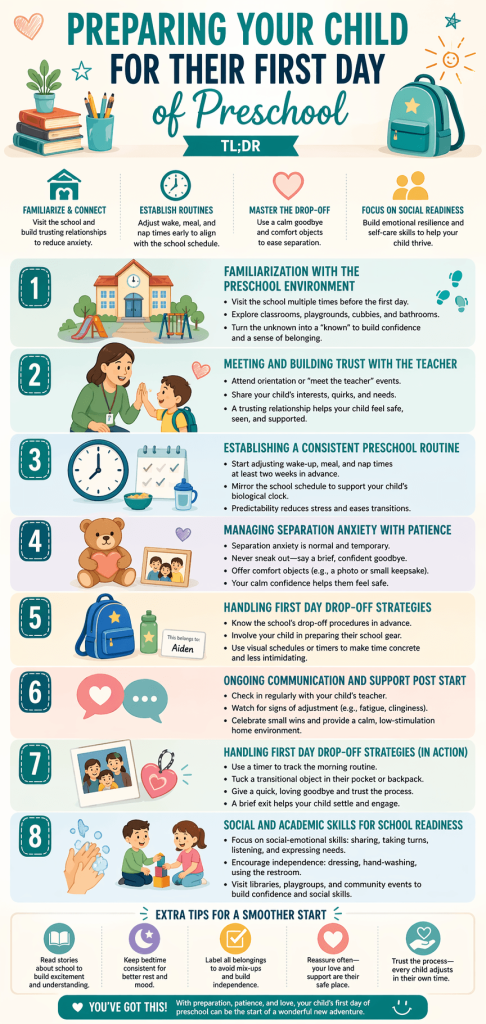
- Familiarize and Connect: Reduce anxiety by visiting the school campus multiple times and building a trusting relationship with the teacher before the first day.
- Establish Routines: Start adjusting wake-up, meal, and nap times two weeks in advance to align your child’s biological clock with the school schedule.
- Master the Drop-Off: Manage separation anxiety by practicing a quick, confident goodbye, never sneak out, and using “comfort objects” like family photos to provide security.
- Focus on Social Readiness: Prioritize emotional resilience and self-care skills (like sharing and independent hand-washing) over academic milestones to help your child thrive.
Table of Contents
- Familiarization with the Preschool Environment
- Meeting and Building Trust with the Teacher
- Establishing a Consistent Preschool Routine
- Managing Separation Anxiety with Patience
- Handling First Day Drop Off Strategies
- Ongoing Communication and Support Post Start
- Handling First Day Drop-Off Strategies
- Social and Academic Skills for School Readiness
- Frequently Asked Questions
The first day of preschool is a significant milestone for your little learner. It marks a transition into early childhood education that builds essential social and emotional skills.
As the start of the school year approaches, you might feel a mix of excitement and nerves. This is completely natural for both parents and children during such a big life change.
With the right preparation, you can turn those first day jitters into a sense of adventure. Here is how to ensure a smooth start for your child.
Familiarization with the Preschool Environment
Ease morning anxiety by transforming the school into a familiar destination before the first bell rings. Early childhood expert Annaliese Newmeyer recommends visiting the campus multiple times during the summer to build your child’s confidence. Walking through the playgrounds, locating the cubbies, and identifying the bathrooms helps children visualize their future daily movements. This physical exploration fosters a sense of belonging, turning an intimidating institution into a “known” space, which is the first step in ensuring a smoother, more comfortable preschool transition.
Meeting and Building Trust with the Teacher
Once the physical space feels familiar, the next step is connecting with the people who will lead it. Establishing a positive teacher relationship is vital for long-term school readiness and emotional security. When a child observes a warm, respectful interaction between their parent and their educator, it signals that the teacher is a safe person to trust. Use orientation days or “meet the teacher” events to share your child’s unique interests or quirks; this early exchange helps the educator tailor their approach, ensuring your little one feels seen and supported by a reliable adult from day one.
Establishing a Consistent Preschool Routine
While social bonds are forming, the logistical flow of your day also needs a proactive overhaul to prevent morning chaos. To reduce the shock of a new schedule, start adjusting your home routines at least two weeks before the term begins. Mirror the school’s expected wake-up calls, meal times, and nap windows to align your child’s internal biological clock. This predictability provides a psychological safety net, replacing the frantic energy of a rushed morning with a calm, cooperative rhythm that makes the actual departure for school feel like a natural part of their day.
Managing Separation Anxiety with Patience
While rituals provide a framework, parents must also prepare for the physiological reality of separation anxiety, a common developmental milestone that typically peaks between 18 months and three years of age. It is important to remember that this phase is temporary, though it can take several weeks for a child to fully acclimate to the new routine. The most critical factor in maintaining trust is never “sneaking out” while a child is distracted; doing so can inadvertently heighten their hyper-vigilance. Instead, offer a brief, firm reassurance of your return. By maintaining a composed and confident demeanor, you act as an emotional mirror, showing your child that the school environment is a safe space worthy of their curiosity.
Handling First Day Drop Off Strategies
To ensure these emotional strategies work effectively on the actual morning of arrival, practical logistics should be finalized well in advance. Familiarize yourself with specific school protocols regarding where parents should say goodbye, whether at the classroom door or the school gate, to avoid confusion in the heat of the moment. You can also build excitement by involving your child in the preparation of their school gear, such as choosing a backpack or labeling their water bottle. Using tools like visual schedules or sand timers at home can help children visualize the passage of time, making the concept of “after lunch” or “after nap time” more concrete and less intimidating as they wait for pickup.
Ongoing Communication and Support Post Start
Once the initial drop-off hurdle is cleared, the focus shifts to sustaining this momentum through a proactive partnership with the teaching staff. The first month is a period of rapid adjustment, and regular check-ins with educators can provide insights into your child’s emerging social dynamics and participation levels that you might not see at home. If a child seems unusually exhausted or regresses in areas like sleep or toileting, these are often signs of “after-school restraint collapse,” where they release the emotional energy spent being “good” all day. Providing a low-stimulation environment and celebrating small milestones, like making a new friend or trying a new art project, helps solidify their identity as a capable, lifelong learner.
Handling First Day Drop-Off Strategies
When the actual first morning arrives, your goal is to maintain a calm, steady momentum that reinforces the rituals you have practiced. Start by using visual timers at home to help your child track the countdown to leaving, which reduces the “shock” of departure. You might also tuck a “transitional object,” such as a small family photo or a laminated “kissing hand” heart, into their pocket for comfort during quiet moments. Once you reach the classroom, execute a quick, loving exit. Experts agree that lingering often prolongs the distress for both parent and child; a brief, confident goodbye signals to your child that you are certain they are safe, which helps them settle into the classroom flow more effectively.
Social and Academic Skills for School Readiness
Building on that foundation of home-school communication, it is important to recognize that “readiness” is less about counting to one hundred and more about emotional resilience. Preschool serves as a primary training ground for social-emotional growth, where the ability to share and take turns is the most valuable currency. You can support this at home by encouraging your child to manage self-care tasks, such as zipping their own jacket or washing their hands independently. To prepare them for the sensory experience of a busy classroom, consider visiting community hubs like local library read-aloud sessions or public playgroups. These environments mimic the structured listening and peer interaction they will encounter daily, helping them find their voice when they need to verbalize their needs to an adult.
Frequently Asked Questions
How long does it take for a child to stop crying?
While every child follows a unique emotional timeline, most settle into their new environment within a month. However, it is perfectly normal for some children to experience “re-entry anxiety” after weekends or holiday breaks, which can extend the adjustment period to nearly ten weeks. To support this process, consider tucking a family photograph or a small “comfort object” into their backpack to provide a sensory link to home. Reading age-appropriate stories about school life during evening routines can also help demystify their experiences. Ultimately, your child’s ability to thrive depends on the gradual development of a secure attachment with their lead teacher, which replaces initial fear with a sense of belonging.
References
- 13 Tips for Starting Preschool | NAEYC
- Ready for Preschool: Tips to Prepare Your 3- or 4-Year-Old Child
- First Day of Preschool: Tips for Separation Anxiety and More – Parents
- Preparing Your Child for Their First Day of Preschool: A Parent’s Guide
- How can I best prepare my child and myself for daycare/preschool?